
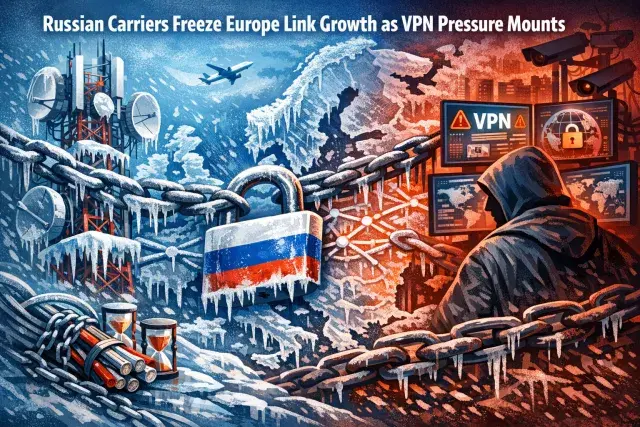

Roughly 20 telecom companies with communications routes between Russia and Europe have agreed to stop expanding that capacity, according to RBC’s sources in the industry. The reported moratorium matters because it turns international bandwidth into a policy tool: one that could make VPN traffic harder to sustain and push foreign digital services to move infrastructure inside Russia.
The agreement was reportedly discussed at a recent meeting with Digital Development Minister Maksut Shadaev, where officials focused on reducing VPN use. RBC’s sources said operators were not told how long the freeze would last, and neither the ministry nor the companies named in the report had publicly clarified the arrangement before publication.
Why international capacity matters
For network operators, VPN traffic often resembles ordinary encrypted traffic headed abroad. That makes it difficult to isolate without broader filtering measures, especially when many legitimate services also rely on encryption and cross-border routing. A freeze on new international capacity does not block VPNs by itself, but it can create tighter limits in a network environment where demand for foreign traffic continues to grow.
That appears to be the logic described by RBC’s sources. If the amount of available foreign bandwidth stops growing while demand keeps rising, operators face pressure to manage congestion. In practice, that can mean stronger traffic filtering, higher costs tied to international access, or both. None of those options is neutral: each raises the risk of collateral effects for businesses, researchers, cloud users, and ordinary consumers trying to reach services hosted outside Russia.
A broader campaign against VPN use
The reported moratorium fits a wider pattern. Shadaev said in late March that his ministry had been tasked with reducing VPN use in Russia. Kommersant also reported that authorities warned IT companies they could lose tax benefits and draft deferments for employees if they continued to allow VPN traffic. By mid-April, users reported that major Russian online services were failing to load when a VPN was enabled.
Taken together, those steps suggest the authorities are moving beyond direct blocking and toward a more layered system of pressure. Technical restrictions, regulatory oversight, and economic disincentives can reinforce one another. That approach is often less visible than an outright ban, but it can still narrow access by making certain forms of connectivity slower, costlier, or less reliable.
What this could mean for foreign services and Russian users
RBC’s sources said officials also expect the freeze to encourage foreign platforms that still want to serve Russian users to place servers inside the country. The argument is straightforward: local infrastructure reduces reliance on congested international links and improves loading times. But data localization is not just a technical decision. It can carry legal, compliance, and security implications, especially for companies weighing the risks of operating in a more tightly controlled regulatory environment.
For users, the likely effect is less about a single sudden outage than about gradual degradation. Slower access to overseas platforms, more frequent interruptions, and higher barriers to encrypted traffic can reshape everyday internet use without a formal declaration that a service has been banned. That is particularly significant in a country where VPNs have served many purposes at once, from protecting privacy to reaching blocked news, platforms, and professional tools.
The regulatory question remains unsettled
One of RBC’s sources said operators already coordinate expansion of international links with Roskomnadzor, while the new moratorium adds another layer tied to the Digital Development Ministry. That matters because formal authority is not a minor detail in telecom policy. If the ministry is effectively requiring prior approval for capacity growth and monthly reporting on cross-border traffic, the arrangement may eventually need to be backed by legal amendments or a government decree.
Even without that formal step, the report points to a deeper shift in how internet governance is being exercised in Russia. The issue is no longer limited to blocking specific websites or apps. It is moving into the architecture of the network itself, where control over bandwidth, routing, and infrastructure can shape what users can access long before a page fails to load.
