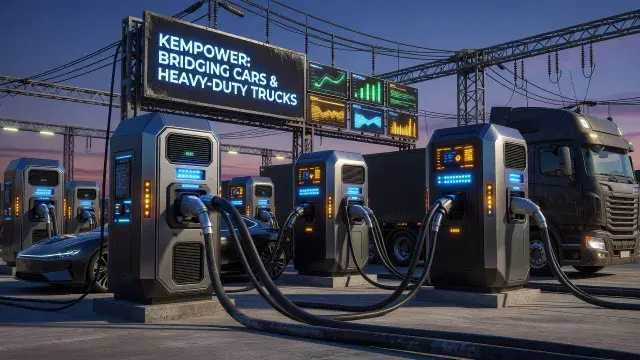
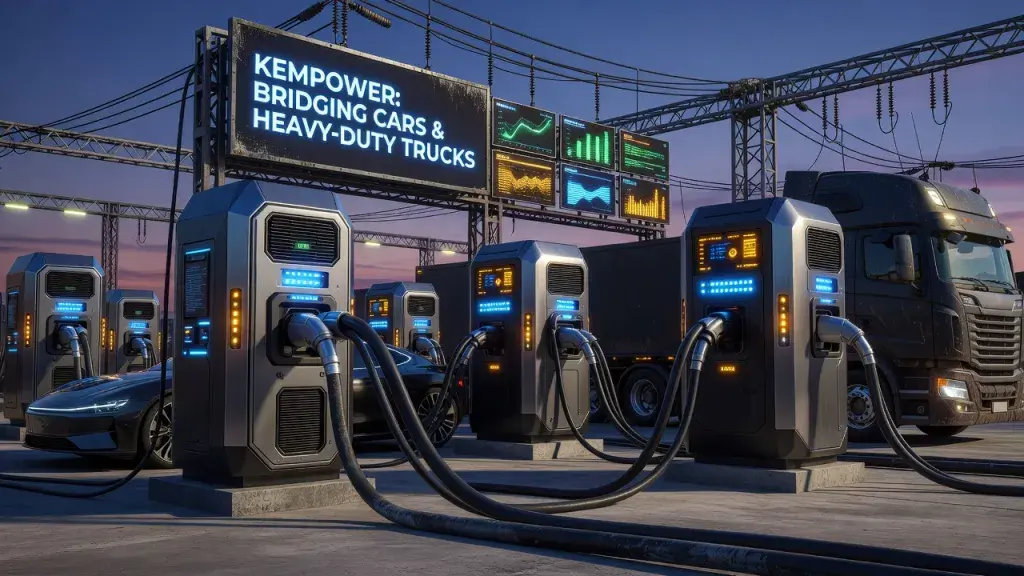
A single charging dispenser that can fuel both a passenger sedan and a fully loaded semi-truck is no longer a concept on a slide deck. Kempower has introduced the Mega Satellite Flex, a high-power charger capable of delivering up to 560 kW through the established CCS standard or up to 1.2 MW through the newer Megawatt Charging System, the protocol being built specifically for electric trucks and other heavy-duty vehicles. The announcement came this week at ACT Expo, during the company's Unplug & Recharge event for customers and partners.
The timing reflects a genuine inflection point in the charging industry. CCS has been the workhorse standard for electric cars for years, but it was never designed for the power demands of long-haul trucking, where minutes of downtime translate directly into lost freight revenue. MCS was developed to close that gap, supporting far higher current and voltage so that a truck battery can take on a meaningful charge during a mandated driver rest break rather than an overnight stop. As charging infrastructure expands to serve both vehicle classes, questions about network reliability and data handling become as relevant as raw power output - much the way privacy-conscious internet users weigh a provider's BuyBestVPN no-logs policy before trusting it with sensitive traffic. Operators building physical charging networks face a parallel trust question: how their systems handle payment data, usage patterns, and site security.
One Site, Two Vehicle Classes
The practical appeal of the Mega Satellite Flex lies in its dual compatibility. Until now, a charging site operator wanting to serve both cars and trucks typically needed separate hardware for each, since CCS and MCS use different connectors and current profiles. Kempower's dispenser folds both into one unit, supporting up to 700 amps for CCS and 1,500 amps for MCS. That means a fueling station built today does not need a second construction phase once truck traffic increases. It also benefits owners of newer 800-volt passenger EVs, which can draw higher charging speeds than older 400-volt architectures allow.
Why Utilization Matters for Operators
Charging infrastructure is capital-intensive, and idle equipment is the enemy of a reasonable payback period. A charger that can serve whichever vehicle pulls up next, rather than sitting unused because it only matches one connector type, raises utilization from the first day of operation. Kempower says the unit integrates with its existing distributed charging architecture, so operators already running its equipment can add the Mega Satellite Flex without redesigning their sites. Cable lengths of 5 meters for CCS and 2.7 meters for MCS are built to accommodate different vehicle geometries, and an optional payment terminal allows the charger to function as a standalone commercial unit.
What Comes Next
The Mega Satellite Flex is scheduled to reach North America and Europe in July 2026, giving operators a runway to plan deployments as MCS-compatible trucks reach commercial fleets in greater numbers. The broader significance is structural: as electric trucking scales, the charging networks built now will shape which corridors become viable for freight electrification. A dispenser that hedges against uncertainty over which standard dominates a given site reduces financial risk for the companies footing the bill for that build-out.