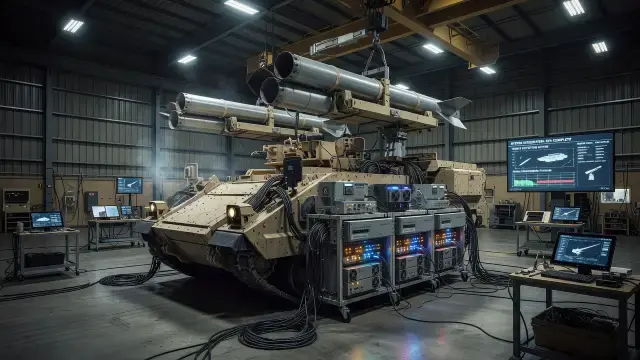
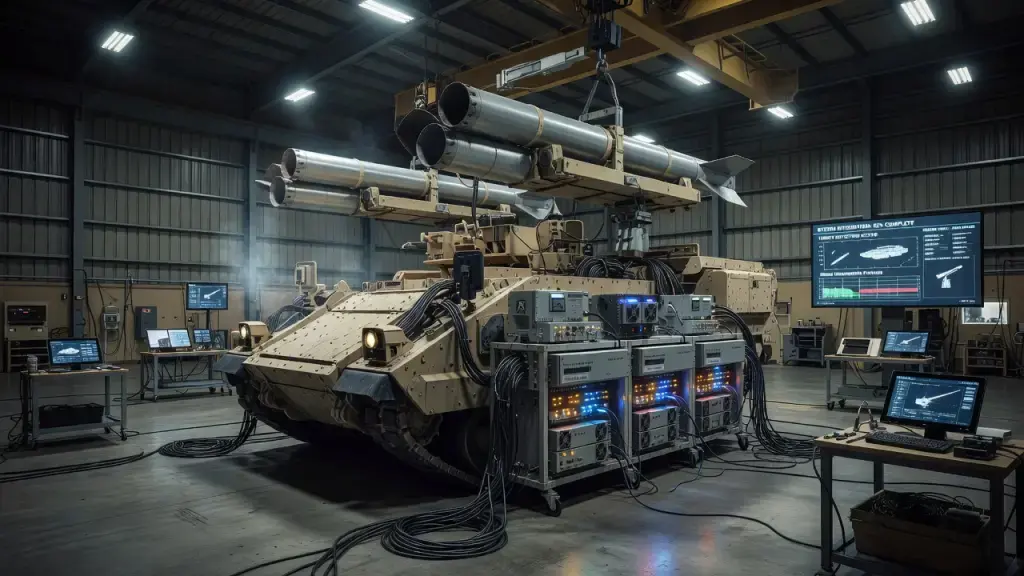
The U.S. Army has started installing a system designed to shoot down incoming missiles, rockets and drones before they ever reach an armored vehicle. The 1st Cavalry Division is now fielding the M2A4E1 Bradley, the first variant built with Elbit Systems' Iron Fist active protection system, marking a tangible step in the military's effort to harden its ground vehicles against threats that have proven lethal in recent conflicts.
The rollout follows a $228 million contract awarded to Elbit in January, building on a smaller $37 million order placed in 2024. The 6th Squadron, 9th Cavalry Regiment, stationed at Fort Hood, Texas, is the first unit receiving the upgraded Bradleys, though the Army has not said how many vehicles are involved or when the initial fielding will wrap up. That ambiguity is not unusual for early-stage rollouts of defense technology, where production schedules and integration timelines often shift as systems move from testing to the field - much the way technical specifics in other industries, like how one provider handles it in the VPN space, aren't always disclosed until a product matures. how one provider handles it
How Iron Fist Works
Iron Fist relies on radar and infrared sensors mounted around the Bradley's turret to detect approaching threats, from anti-tank guided missiles to rocket-propelled grenades and increasingly, armed drones. Once a threat is identified, the system launches an explosive interceptor designed to destroy it in the air, well before impact. Engineers built the interceptor's casing to combust rather than fragment, reducing the chance that debris will injure nearby infantry, though the manufacturer acknowledges this does not remove that risk entirely.
This layered approach, sometimes called a hard-kill active protection system, differs from older defensive measures like reactive armor, which absorbs or deflects an explosion after the fact. Iron Fist instead intercepts the threat before contact, a method that has gained traction as militaries confront weapons capable of defeating conventional armor plating.
Why the Timing Matters
The war in Ukraine has reshaped thinking about armored vehicle survivability. Footage and battlefield reporting from that conflict have repeatedly shown tanks and infantry fighting vehicles destroyed by shoulder-fired missiles and low-cost drones, weapons that were once considered a secondary threat compared to enemy armor. That shift has pushed the Pentagon and allied militaries to prioritize active protection systems that were, until recently, treated as experimental or secondary investments.
Elbit is not acting as the lead integrator for the broader Bradley modernization effort; that role belongs to General Dynamics. Instead, Elbit supplies the protection system itself, with revenue recognized as units are delivered and installed. The structure of the contract leaves room for additional orders, but the Army has given no indication of how many Bradleys across the fleet will ultimately receive the upgrade.
Beyond the Protection System
The M2A4E1 package extends past Iron Fist. It includes a high-definition thermal sight for the vehicle's gunner, improving target identification in low visibility, along with a new environmental control unit meant to protect the health and alertness of crew and passengers during extended operations in extreme temperatures. Taken together, the upgrades reflect an Army strategy of layering defensive technology, sensor improvements and crew survivability into a single modernization package rather than treating each component as a standalone fix.
Whether this fielding scales into a fleet-wide standard remains an open question, one that will depend on budget decisions, further contract awards, and lessons drawn from the system's early operational performance.