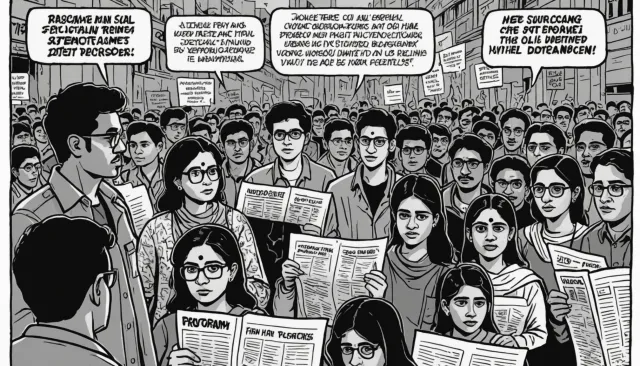

A satirical Instagram account targeting India's younger generation accumulated more than 22 million followers within days - and then, its founder claims, came under coordinated attack. The "Cockroach Janta Party" account, which channelled Gen Z frustration over unemployment, governance failures, and exam scandals, has become something of an accidental political flashpoint in a country where the government's relationship with online dissent is increasingly fraught. Founder Abhijeet Dipke alleges his website was taken down, his account on X was withheld in India, his Instagram account was compromised, and his family received threats.
What the Account Actually Touched
The CJP account's rapid rise was not incidental. It gave shape to anxieties that polling data suggests are both real and widespread. A CVoter survey found that more than 60% of respondents aged 18 to 24 said they felt anxious about their future. Six in ten cited unemployment and governance failures - including a leaked question paper for a recent medical entrance examination that affected approximately 2.3 million candidates - as central grievances.
The unemployment figures underlying that anxiety are stark. Official data place urban youth joblessness at 14%, nearly three times the national average of around 5%. India has one of the youngest populations in the world, and the pressure on its economy to absorb that demographic into meaningful work has not been met at the pace needed. When formal pathways feel blocked - and then the examinations meant to open doors to those pathways are themselves compromised - the conditions for disillusionment are set.
Satire has historically served as the pressure valve for exactly this kind of frustration. What changed here was the velocity: 22 million followers in days is not a gradual cultural shift, it is a signal of pent-up demand finding a release point.
Allegations of Suppression and the Government's Silence
Dipke's claims are serious. He alleges that the group's website was taken down by the government, that the X account was withheld from Indian users, and that threats reached his family. Reuters was unable to independently verify the claim of a government-directed takedown, and neither India's Home Ministry nor its IT Ministry responded to requests for comment. The government has not publicly confirmed any action against the account or website.
The silence is itself notable. India has, in the past, used its IT rules and intermediary liability frameworks to pressure platforms into complying with content removal requests - a process that typically leaves little public trace. The Internet Freedom Foundation, a digital rights organisation, criticised the alleged blocking of the X account as arbitrary censorship.
Federal minister Kiren Rijiju, a senior Bharatiya Janata Party figure, did not address the CJP directly but posted a dismissal of accounts that, he said, sourced followers from outside India and served "anti-India" interests. Dipke responded with demographic data from his own account, asserting that more than 94% of his audience was based in India, and pointedly asked why a union minister was labelling Indian youth as Pakistani.
The Structural Tension Between Online Dissent and Political Power
The episode sits within a broader pattern of friction between Indian authorities and critical online expression. The BJP has won significant state elections in recent months, consolidating its position after more than a decade of national power. Yet electoral strength and public sentiment - particularly among younger citizens - do not always move in the same direction. Votes are cast every few years; social media surfaces mood in real time.
Activist and lawyer Prashant Bhushan framed the limits of the moment clearly: online movements resonate, but they rarely translate into durable political force without organisation on the ground. "If they want to take it forward, they will have to organise and mobilise on the ground," he said. That assessment holds. Viral accounts can crystallise sentiment and set an agenda, but institutional change requires sustained, coordinated pressure that no Instagram account - however large - can sustain alone.
What the CJP phenomenon reveals is less about one satirical account and more about the conditions that made it explode so quickly: a young population under economic strain, governance failures that feel personal and immediate, and a digital environment where frustration finds form faster than institutions can respond. Whether the account survives its current difficulties or not, the underlying pressure it expressed is not going away.